> ## Documentation Index
> Fetch the complete documentation index at: https://lightdash-mintlify-87860eff.mintlify.site/llms.txt
> Use this file to discover all available pages before exploring further.
# Formula table calculations
> Build table calculations using a spreadsheet-style formula syntax instead of raw SQL.
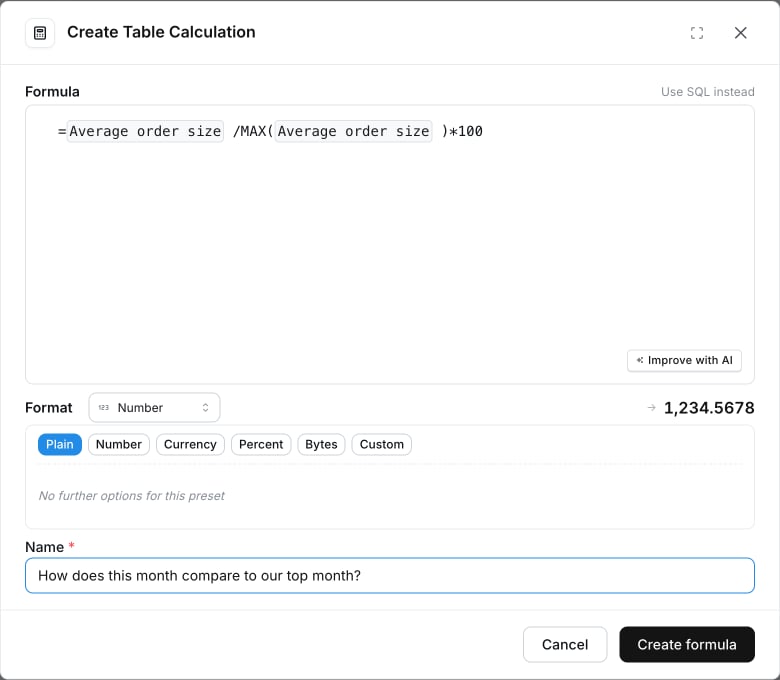
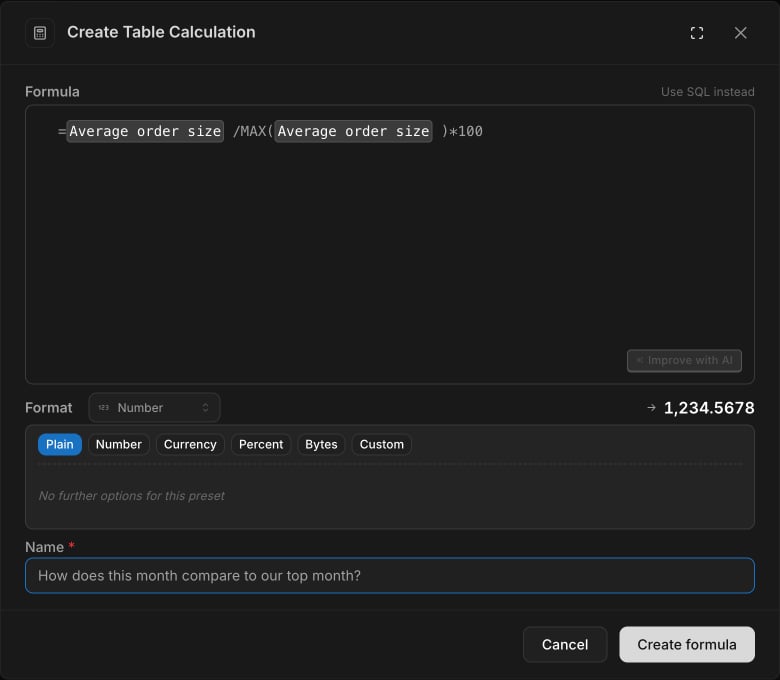
Formula table calculations let you write table calculations in a
spreadsheet-style syntax, the way you would in Google Sheets or Excel,
instead of raw SQL. When you create a new [table calculation](/guides/table-calculations),
**Formula** is the default input mode. You can switch to the SQL editor
any time.
 ## Why use formulas?
* **Faster to write** for common calculations. No `OVER (…)` or
`CASE WHEN` boilerplate to remember.
* **Familiar** if you've used Google Sheets, Excel, or Airtable.
* **Portable** across warehouses. The same formula compiles to the
correct SQL for whichever warehouse your project is connected to.
If you need something the formula syntax doesn't cover yet, the SQL
editor is always one click away.
## Supported warehouses
Formula table calculations work on every warehouse Lightdash supports:
Athena, BigQuery, ClickHouse, Databricks, DuckDB, PostgreSQL, Redshift,
Snowflake, and Trino. The same formula compiles to the correct SQL for
whichever warehouse your project is connected to.
## Writing your first formula
Every formula starts with `=`. Reference a field by its column name
(the same name you see in the results table header):
```
=orders_total_order_amount * 1.2
```
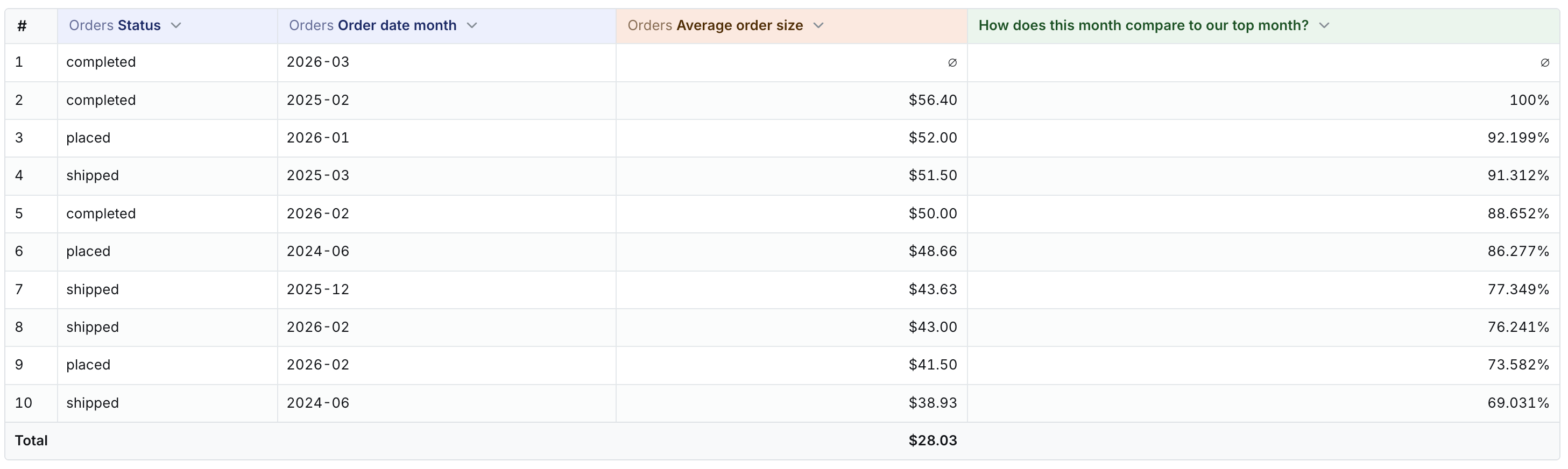
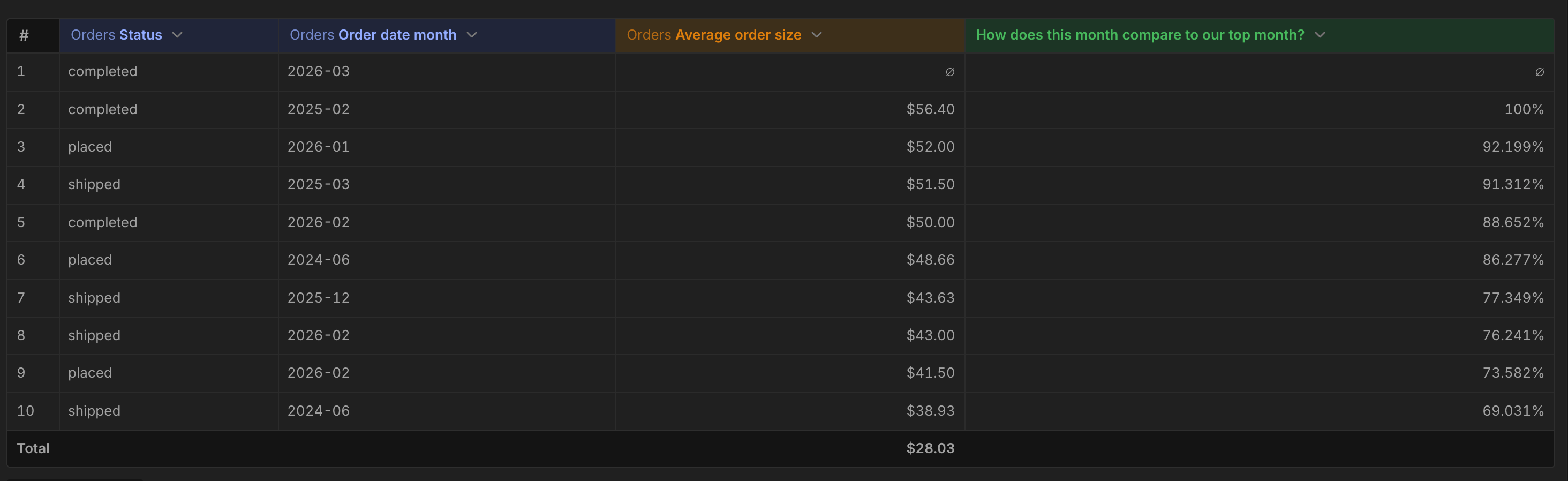
The result appears as a new green column in your results table:
## Why use formulas?
* **Faster to write** for common calculations. No `OVER (…)` or
`CASE WHEN` boilerplate to remember.
* **Familiar** if you've used Google Sheets, Excel, or Airtable.
* **Portable** across warehouses. The same formula compiles to the
correct SQL for whichever warehouse your project is connected to.
If you need something the formula syntax doesn't cover yet, the SQL
editor is always one click away.
## Supported warehouses
Formula table calculations work on every warehouse Lightdash supports:
Athena, BigQuery, ClickHouse, Databricks, DuckDB, PostgreSQL, Redshift,
Snowflake, and Trino. The same formula compiles to the correct SQL for
whichever warehouse your project is connected to.
## Writing your first formula
Every formula starts with `=`. Reference a field by its column name
(the same name you see in the results table header):
```
=orders_total_order_amount * 1.2
```
The result appears as a new green column in your results table:
 You can use:
* **Numbers**: `42`, `3.14`, `-1.5`
* **Strings**: `"hello"` or `'hello'`
* **Booleans**: `TRUE`, `FALSE`
* **Column references**: any field present in your results table
* **Arithmetic operators**: `+`, `-`, `*`, `/`, `%` (modulo)
* **Comparison operators**: `=`, `<>`, `>`, `<`, `>=`, `<=`
* **Boolean operators**: `AND`, `OR`, `NOT`
## Function reference
### Math
| Function | Description |
| ------------------------ | ----------------------------- |
| `ABS(x)` | Absolute value |
| `ROUND(x, [digits])` | Round to N decimal places |
| `CEIL(x)` / `CEILING(x)` | Round up to nearest integer |
| `FLOOR(x)` | Round down to nearest integer |
| `MIN(x, [y])` | Minimum (scalar or aggregate) |
| `MAX(x, [y])` | Maximum (scalar or aggregate) |
### Logical
| Function | Description |
| ------------------------------- | ---------------------- |
| `IF(condition, then, [else])` | Conditional expression |
| `AND`, `OR`, `NOT` | Boolean operators |
| `=`, `<>`, `>`, `<`, `>=`, `<=` | Comparison operators |
### String
| Function | Description |
| ---------------------- | -------------------- |
| `CONCAT(a, b, …)` | Concatenate strings |
| `LEN(s)` / `LENGTH(s)` | String length |
| `TRIM(s)` | Remove whitespace |
| `LOWER(s)` | Convert to lowercase |
| `UPPER(s)` | Convert to uppercase |
### Date
| Function | Description |
| ----------------------------- | ----------------------------------------------------------------------------------------- |
| `TODAY()` | Current date |
| `NOW()` | Current timestamp |
| `YEAR(d)` | Extract year |
| `MONTH(d)` | Extract month |
| `DAY(d)` | Extract day |
| `LAST_DAY(d)` | Last day of the month containing `d` |
| `DATE_TRUNC(d, unit)` | Truncate `d` to the start of `unit` (`"day"`, `"week"`, `"month"`, `"quarter"`, `"year"`) |
| `DATE_ADD(d, n, unit)` | Add `n` whole `unit`s to `d` (e.g. `DATE_ADD(orders_date, 3, "month")`) |
| `DATE_SUB(d, n, unit)` | Subtract `n` whole `unit`s from `d` |
| `DATE_DIFF(start, end, unit)` | Whole-`unit` calendar-boundary difference. Positive when `end > start`. |
`unit` is always one of `"day"`, `"week"`, `"month"`, `"quarter"`,
`"year"` — quoted as a string literal.
### Aggregation
| Function | Description |
| ------------------------- | --------------------------- |
| `SUM(x)` | Sum values |
| `AVG(x)` / `AVERAGE(x)` | Average values |
| `COUNT([x])` | Count rows (or non-null x) |
| `SUMIF(condition, x)` | Sum where condition is true |
| `AVERAGEIF(condition, x)` | Avg where condition is true |
| `COUNTIF(condition)` | Count where condition true |
### Window
| Function | Description |
| ------------------------------ | ------------------------------ |
| `RUNNING_TOTAL(x)` | Running (cumulative) total |
| `ROW_NUMBER()` | Sequential row number |
| `RANK()` | Rank with gaps |
| `DENSE_RANK()` | Rank without gaps |
| `LAG(x, [offset], [default])` | Previous row's value |
| `LEAD(x, [offset], [default])` | Next row's value |
| `FIRST(x)` | First value in window |
| `LAST(x)` | Last value in window |
| `NTILE(n)` | Distribute rows into N buckets |
| `MOVING_SUM(x, n)` | Sum of the last N rows |
| `MOVING_AVG(x, n)` | Average of the last N rows |
### Null handling
| Function | Description |
| ------------------- | ----------------------- |
| `COALESCE(a, b, …)` | First non-null argument |
| `ISNULL(x)` | `TRUE` if x is null |
## Window clauses: `PARTITION BY` and `ORDER BY`
Window functions accept optional `PARTITION BY` and `ORDER BY` clauses,
written inline as extra arguments. Use them when you want a running
total, moving average, rank, or `LAG`/`LEAD` to reset for each group or
follow a specific row order.
* `PARTITION BY ` — restart the calculation for each value
of the dimension (for example, run a separate running total per
region).
* `ORDER BY ` — define the row order the window uses (for
example, by date). Defaults to the natural sort of your results table
when omitted.
**Running total per group**
```
=RUNNING_TOTAL(orders_revenue, PARTITION BY orders_region, ORDER BY orders_order_date)
```
**Moving average per group**
```
=MOVING_AVG(orders_revenue, 6, PARTITION BY orders_partner_name, ORDER BY orders_order_month)
```
**Percent change vs. previous row in the same group**
```
=(orders_revenue - LAG(orders_revenue, PARTITION BY orders_region, ORDER BY orders_order_date))
/ LAG(orders_revenue, PARTITION BY orders_region, ORDER BY orders_order_date)
```
**Rank within each group**
```
=RANK(PARTITION BY orders_region, ORDER BY orders_revenue DESC)
```
You can also wrap any aggregate with an explicit `OVER (…)` clause for
warehouse-style window aggregates:
```
=SUM(orders_revenue) OVER (PARTITION BY orders_region ORDER BY orders_order_date)
```
## Examples
**Gross margin as a percentage**
```
=ROUND((orders_revenue - orders_cost) / orders_revenue * 100, 2)
```
**Flag high-value orders**
```
=IF(orders_total_amount > 1000, "VIP", "Standard")
```
**Running total of revenue**
```
=RUNNING_TOTAL(orders_revenue)
```
**Period-over-period growth %**
```
=(orders_revenue - LAG(orders_revenue, 1, 0)) / LAG(orders_revenue, 1, 0) * 100
```
**Bucket customers by spend**
```
=IF(customers_lifetime_value > 10000, "Platinum",
IF(customers_lifetime_value > 5000, "Gold",
IF(customers_lifetime_value > 1000, "Silver", "Bronze")))
```
**Percent of total**
```
=orders_revenue / SUM(orders_revenue) * 100
```
## FAQ
No. The input mode is chosen when you create the table calculation
and can't be changed afterwards, because formulas and SQL aren't
always losslessly interconvertible. If you need to move a SQL calc to
a formula (or vice versa), delete the old one and create a new one in
the mode you want.
Post in the [Lightdash Community Slack](https://join.slack.com/t/lightdash-community/shared_invite/zt-3pbwqmq5e-vhTc7HHcS787w618ngoPHA)
or [open a GitHub issue](https://github.com/lightdash/lightdash/issues).
See [Contact Us](/contact/contact-info) for more options.
## Related
* [Table calculations overview](/guides/table-calculations)
* [Table calculation functions](/references/table-calculation-functions/row-functions)
* [SQL templates for table calculations](/guides/table-calculations/sql-templates)
You can use:
* **Numbers**: `42`, `3.14`, `-1.5`
* **Strings**: `"hello"` or `'hello'`
* **Booleans**: `TRUE`, `FALSE`
* **Column references**: any field present in your results table
* **Arithmetic operators**: `+`, `-`, `*`, `/`, `%` (modulo)
* **Comparison operators**: `=`, `<>`, `>`, `<`, `>=`, `<=`
* **Boolean operators**: `AND`, `OR`, `NOT`
## Function reference
### Math
| Function | Description |
| ------------------------ | ----------------------------- |
| `ABS(x)` | Absolute value |
| `ROUND(x, [digits])` | Round to N decimal places |
| `CEIL(x)` / `CEILING(x)` | Round up to nearest integer |
| `FLOOR(x)` | Round down to nearest integer |
| `MIN(x, [y])` | Minimum (scalar or aggregate) |
| `MAX(x, [y])` | Maximum (scalar or aggregate) |
### Logical
| Function | Description |
| ------------------------------- | ---------------------- |
| `IF(condition, then, [else])` | Conditional expression |
| `AND`, `OR`, `NOT` | Boolean operators |
| `=`, `<>`, `>`, `<`, `>=`, `<=` | Comparison operators |
### String
| Function | Description |
| ---------------------- | -------------------- |
| `CONCAT(a, b, …)` | Concatenate strings |
| `LEN(s)` / `LENGTH(s)` | String length |
| `TRIM(s)` | Remove whitespace |
| `LOWER(s)` | Convert to lowercase |
| `UPPER(s)` | Convert to uppercase |
### Date
| Function | Description |
| ----------------------------- | ----------------------------------------------------------------------------------------- |
| `TODAY()` | Current date |
| `NOW()` | Current timestamp |
| `YEAR(d)` | Extract year |
| `MONTH(d)` | Extract month |
| `DAY(d)` | Extract day |
| `LAST_DAY(d)` | Last day of the month containing `d` |
| `DATE_TRUNC(d, unit)` | Truncate `d` to the start of `unit` (`"day"`, `"week"`, `"month"`, `"quarter"`, `"year"`) |
| `DATE_ADD(d, n, unit)` | Add `n` whole `unit`s to `d` (e.g. `DATE_ADD(orders_date, 3, "month")`) |
| `DATE_SUB(d, n, unit)` | Subtract `n` whole `unit`s from `d` |
| `DATE_DIFF(start, end, unit)` | Whole-`unit` calendar-boundary difference. Positive when `end > start`. |
`unit` is always one of `"day"`, `"week"`, `"month"`, `"quarter"`,
`"year"` — quoted as a string literal.
### Aggregation
| Function | Description |
| ------------------------- | --------------------------- |
| `SUM(x)` | Sum values |
| `AVG(x)` / `AVERAGE(x)` | Average values |
| `COUNT([x])` | Count rows (or non-null x) |
| `SUMIF(condition, x)` | Sum where condition is true |
| `AVERAGEIF(condition, x)` | Avg where condition is true |
| `COUNTIF(condition)` | Count where condition true |
### Window
| Function | Description |
| ------------------------------ | ------------------------------ |
| `RUNNING_TOTAL(x)` | Running (cumulative) total |
| `ROW_NUMBER()` | Sequential row number |
| `RANK()` | Rank with gaps |
| `DENSE_RANK()` | Rank without gaps |
| `LAG(x, [offset], [default])` | Previous row's value |
| `LEAD(x, [offset], [default])` | Next row's value |
| `FIRST(x)` | First value in window |
| `LAST(x)` | Last value in window |
| `NTILE(n)` | Distribute rows into N buckets |
| `MOVING_SUM(x, n)` | Sum of the last N rows |
| `MOVING_AVG(x, n)` | Average of the last N rows |
### Null handling
| Function | Description |
| ------------------- | ----------------------- |
| `COALESCE(a, b, …)` | First non-null argument |
| `ISNULL(x)` | `TRUE` if x is null |
## Window clauses: `PARTITION BY` and `ORDER BY`
Window functions accept optional `PARTITION BY` and `ORDER BY` clauses,
written inline as extra arguments. Use them when you want a running
total, moving average, rank, or `LAG`/`LEAD` to reset for each group or
follow a specific row order.
* `PARTITION BY ` — restart the calculation for each value
of the dimension (for example, run a separate running total per
region).
* `ORDER BY ` — define the row order the window uses (for
example, by date). Defaults to the natural sort of your results table
when omitted.
**Running total per group**
```
=RUNNING_TOTAL(orders_revenue, PARTITION BY orders_region, ORDER BY orders_order_date)
```
**Moving average per group**
```
=MOVING_AVG(orders_revenue, 6, PARTITION BY orders_partner_name, ORDER BY orders_order_month)
```
**Percent change vs. previous row in the same group**
```
=(orders_revenue - LAG(orders_revenue, PARTITION BY orders_region, ORDER BY orders_order_date))
/ LAG(orders_revenue, PARTITION BY orders_region, ORDER BY orders_order_date)
```
**Rank within each group**
```
=RANK(PARTITION BY orders_region, ORDER BY orders_revenue DESC)
```
You can also wrap any aggregate with an explicit `OVER (…)` clause for
warehouse-style window aggregates:
```
=SUM(orders_revenue) OVER (PARTITION BY orders_region ORDER BY orders_order_date)
```
## Examples
**Gross margin as a percentage**
```
=ROUND((orders_revenue - orders_cost) / orders_revenue * 100, 2)
```
**Flag high-value orders**
```
=IF(orders_total_amount > 1000, "VIP", "Standard")
```
**Running total of revenue**
```
=RUNNING_TOTAL(orders_revenue)
```
**Period-over-period growth %**
```
=(orders_revenue - LAG(orders_revenue, 1, 0)) / LAG(orders_revenue, 1, 0) * 100
```
**Bucket customers by spend**
```
=IF(customers_lifetime_value > 10000, "Platinum",
IF(customers_lifetime_value > 5000, "Gold",
IF(customers_lifetime_value > 1000, "Silver", "Bronze")))
```
**Percent of total**
```
=orders_revenue / SUM(orders_revenue) * 100
```
## FAQ
No. The input mode is chosen when you create the table calculation
and can't be changed afterwards, because formulas and SQL aren't
always losslessly interconvertible. If you need to move a SQL calc to
a formula (or vice versa), delete the old one and create a new one in
the mode you want.
Post in the [Lightdash Community Slack](https://join.slack.com/t/lightdash-community/shared_invite/zt-3pbwqmq5e-vhTc7HHcS787w618ngoPHA)
or [open a GitHub issue](https://github.com/lightdash/lightdash/issues).
See [Contact Us](/contact/contact-info) for more options.
## Related
* [Table calculations overview](/guides/table-calculations)
* [Table calculation functions](/references/table-calculation-functions/row-functions)
* [SQL templates for table calculations](/guides/table-calculations/sql-templates)